Pemvidutide in MASH: non-invasive liver markers improve at 48 weeks
In a phase 2b trial of adults with MASH and F2 or F3 fibrosis, weekly pemvidutide lowered liver fat, ALT and fibrosis scores versus placebo at 48 weeks.
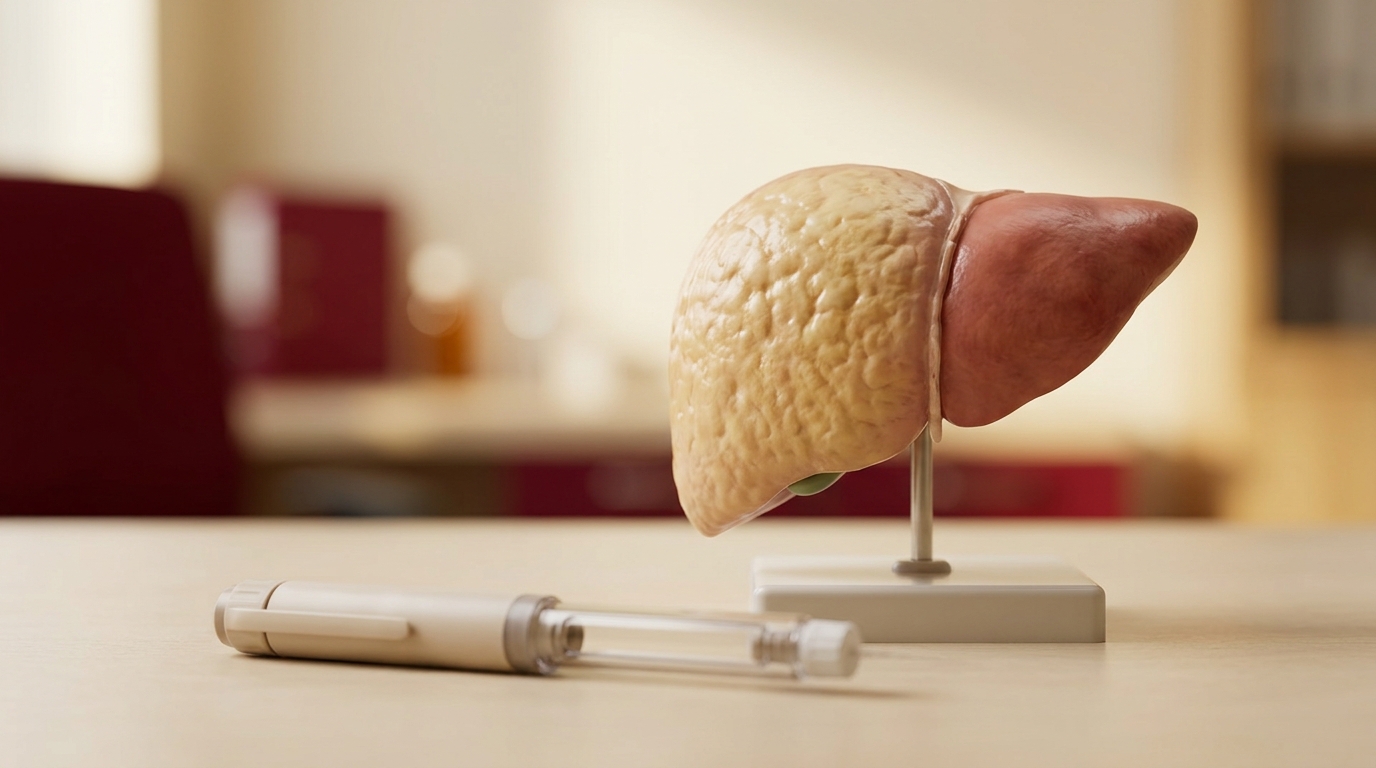
At a glance
- At 48 weeks, liver fat fell by 45.2% (1.2 mg) and 54.7% (1.8 mg) with pemvidutide, versus 8.2% with placebo.
- ALT, corrected T1 relaxation time and enhanced liver fibrosis score also fell more with pemvidutide. No biopsy was done at week 48.
- Nausea was the most frequent pemvidutide-related adverse event. The authors support a phase 3 trial.
Key result
Liver fat fell 45.2% and 54.7% with pemvidutide versus 8.2% with placebo at week 48
Relative change in liver fat content, Week 48
The study
IMPACT was a randomised, double-blind, placebo-controlled, phase 2b trial published in The Lancet Gastroenterology & Hepatology. It enrolled adults with biopsy-confirmed MASH and fibrosis stage F2 or F3 at 83 sites in the USA and Australia. Pemvidutide is a glucagon-GLP-1 dual receptor agonist. The trial was funded by Altimmune.
A total of 212 patients were randomly assigned (1:2:2) to once-weekly subcutaneous pemvidutide 1.2 mg (n=41), pemvidutide 1.8 mg (n=85) or placebo (n=86). Neither dose was titrated. Mean age was 53.4 years and mean BMI was 38.7 kg/m2. In all, 90 patients (42%) had type 2 diabetes. All analyses were in the intention-to-treat population.
The primary endpoints, MASH resolution and fibrosis improvement on biopsy, were assessed at week 24 and reported earlier. This report covers secondary endpoints at week 48. Liver biopsies were not collected at week 48.
What they found
At week 48, relative liver fat content fell by 45.2% with pemvidutide 1.2 mg and by 54.7% with 1.8 mg. It fell by 8.2% with placebo. Both doses differed from placebo (p<0.0001 for each).
Corrected T1 relaxation time fell by 124.2 ms (1.2 mg) and 139.5 ms (1.8 mg). It fell by 20.5 ms with placebo.
Alanine aminotransferase fell by 37.8 IU/L (1.2 mg) and 37.4 IU/L (1.8 mg). It fell by 10.3 IU/L with placebo.
The enhanced liver fibrosis score fell by 0.49 (1.2 mg) and 0.58 (1.8 mg). It rose by 0.16 with placebo. The difference from placebo was p<0.0001 for both doses on all these measures.
The most frequent pemvidutide-related adverse events were:
- Nausea: 9 of 41 patients (22%) at 1.2 mg, 35 of 85 (41%) at 1.8 mg and 15 of 86 (17%) with placebo.
- Diarrhoea: 12% at 1.2 mg, 22% at 1.8 mg and 8% with placebo.
- Constipation: 12% at 1.2 mg, 18% at 1.8 mg and 12% with placebo.
No severe or serious adverse events were defined as related to study medication. Discontinuation due to adverse events occurred in no patients at 1.2 mg, in one patient (1%) at 1.8 mg and in three patients (3%) with placebo.
How much weight to give it
The design is strong for a phase 2b study. It was randomised, double-blind and placebo-controlled, with intention-to-treat analysis. The funder was also masked to treatment assignment.
There are important limits. The authors say the results suggest continued improvement in liver health. But the week 48 findings rest on non-invasive tests and blood markers, which are surrogate outcomes. Without biopsy at week 48, histological MASH resolution and fibrosis change cannot be confirmed at that time point. The abstract does not report cirrhosis, liver-related events, cardiovascular events or deaths. It also does not report follow-up after treatment stopped.
The 1.2 mg group was small (n=41). The trial was funded by Altimmune. It was done in the USA and Australia, and the abstract does not report the ethnic makeup of the patients. The authors conclude that these data warrant a phase 3 trial.
For your clinic
This trial does not change current practice. The abstract does not state the regulatory status of pemvidutide.
It adds to the case that dual glucagon-GLP-1 agonism may act on liver fat and fibrosis markers in people with MASH. In this trial, mean BMI was 38.7 kg/m2 and 42% of patients had type 2 diabetes. The trial was done in the USA and Australia, so the results may not apply directly to every patient group.
Gastrointestinal side effects, mainly nausea, were more common at the higher dose. Read the full paper for the week 24 biopsy results and the safety tables before drawing conclusions. Wait for phase 3 results and guideline updates before changing how MASH is managed.
Source
Safety and efficacy of weekly pemvidutide versus placebo for metabolic dysfunction-associated steatohepatitis (IMPACT): 48-week results from a multicentre, randomised, double-blind, phase 2b study.
Noureddin M, Alkhouri N, Loomba R et al.. The lancet. Gastroenterology & hepatology. 11 November 2026
Cite this report: Diabesity Rounds. Pemvidutide in MASH: non-invasive liver markers improve at 48 weeks. 2026. doi:10.5281/zenodo.24236983
Teaching a session? Download this report as a slide (PNG, free to use with credit).
For registered medical practitioners. This report summarises published research and is not advice for individual patients. Read the full paper and current guidelines before changing practice. Found an error? Write to editor@diabesityrounds.com; see our corrections and editorial policy.
More on fatty liver (masld)
- Efinopegdutide improves MASH histology at 52 weeks in a phase 2b trialRandomised trial · 11 November 2026
- MASLD found in 64.9% of 1,103 adults screened with FibroScan in ChennaiOther study · 5 November 2026
- LITMUS: SomaSignal panel most accurate for at-risk MASH and advanced fibrosisOther study · 31 October 2026
- Resmetirom effects in MASH were similar across common risk genotypesOther study · 10 October 2026
Go deeper
- CASPIAN Certificate in Obesity MedicineRegister interest for the next batch
- Beta Cell AcademyCME for doctors in Hyderabad
Today's Rounds, in your inbox at 8am
The day's reports each morning, and Weekend Rounds on Saturday. Free, no advertising.
Or follow on WhatsApp or Telegram (every report, as it is published), watch on YouTube, listen on Spotify or Apple Podcasts, or follow on LinkedIn. Not sure? Pick one.