Lacto-vegetarian diet and 14-hour fasting lowered HbA1c in women with T2DM
In a 24-week randomised trial of 96 Indian women with type 2 diabetes, a lacto-vegetarian diet with 14-hour fasting gave lower HbA1c and HOMA-IR than usual care.
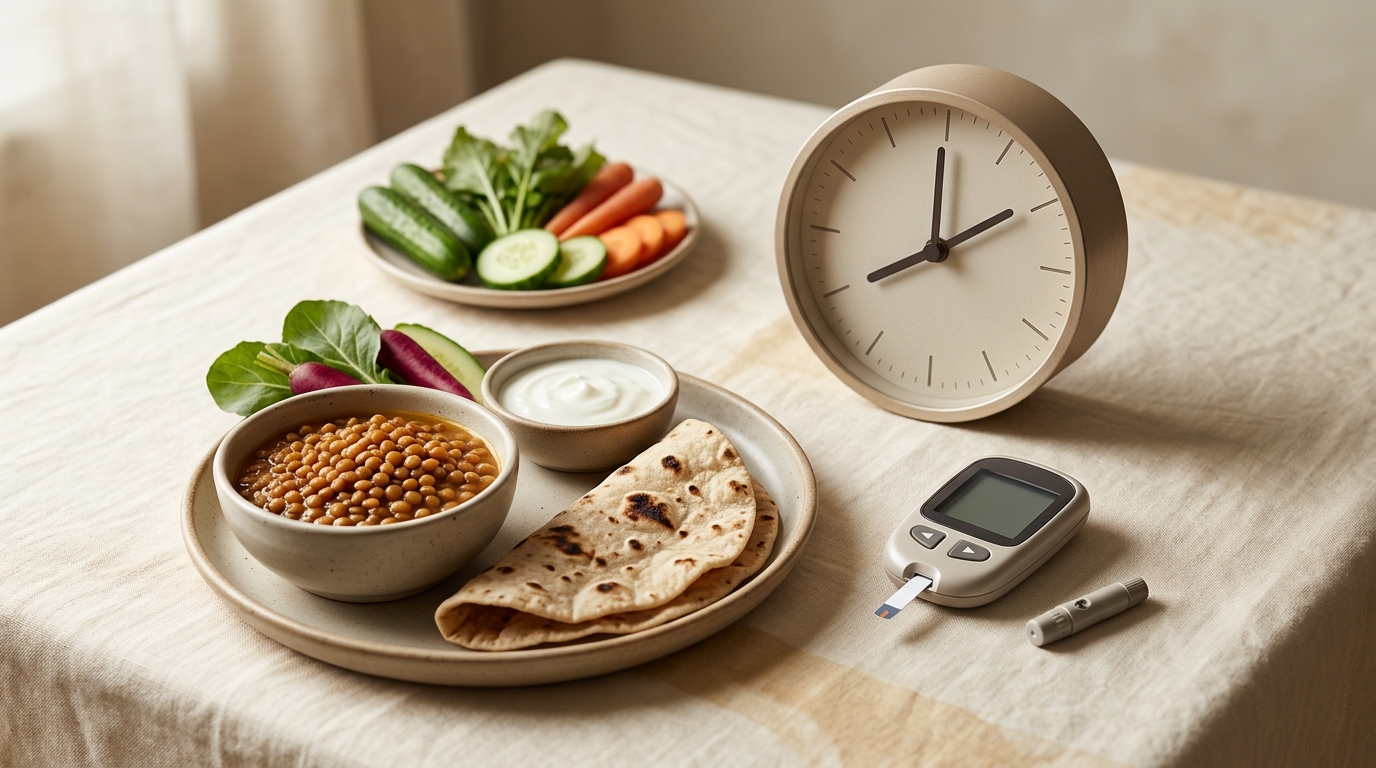
At a glance
- Adjusted HbA1c at 24 weeks was 6.53% with the diet and fasting programme and 7.65% with usual diabetes care.
- HOMA-IR was also significantly lower with the intervention. Body weight, BMI and lipid values were lower too, but the abstract gives no figures for them.
- The trial was open-label and the diet and fasting were tested together, so the effect of each part cannot be separated.
Key result
Adjusted HbA1c was lower with the diet plus 14-hour fasting (6.53%) than usual care (7.65%).
Adjusted mean HbA1c at 24 weeks
The study
This was a 24-week, multicentre, randomised, open-label, parallel-arm trial published in Nutrition & Diabetes. It enrolled 96 women aged 25-60 years with type 2 diabetes. Ninety women completed the study. The trial is registered as CTRI/2024/09/073262.
The intervention group followed a structured lacto-vegetarian diet combined with 14-hour fasting. The diet contained 15-20% protein and 20-25% fat. Carbohydrate quality was improved, with 50-55% coming from whole grains and high-fibre foods. The control group received usual diabetes care. Blood tests and body measurements were taken at baseline and at 24 weeks. The analysis was by intention to treat.
The authors say limited evidence exists on this combined approach in Indian women with type 2 diabetes.
What they found
At 24 weeks, comparisons adjusted for baseline favoured the intervention group. Adjusted values for body weight, BMI, glycaemic measures and lipid profiles were lower in the intervention group. The abstract does not give figures for weight, BMI or lipids.
For HbA1c, the adjusted mean was 6.53% in the intervention group and 7.65% in the control group. The adjusted mean difference was -1.12% (95% CI: -1.35 to -0.89; p < 0.001).
HOMA-IR, a measure of insulin resistance, was also significantly lower in the intervention group. The adjusted mean difference was -1.84 (95% CI: -2.27 to -1.41; p < 0.001).
Adverse events were mild and transient. Most participants reported better energy, mood, weight loss and overall health.
How much weight to give it
The authors conclude that the combined approach "safely improves metabolic control and insulin sensitivity" in women with type 2 diabetes. They also say its staffing requirements, cost and scalability require further evaluation.
This is a randomised trial, which is a strong design for testing cause and effect. Several points limit how far the result can be taken:
- The trial was open-label. Participants and staff knew who was in which group. This matters most for the self-reported benefits such as mood and energy.
- The diet and the fasting window were tested together. The trial cannot show which part produced the effect.
- HbA1c, HOMA-IR, weight and lipids are surrogate outcomes. The abstract reports no data on heart, kidney or other long-term outcomes.
- The trial lasted 24 weeks. The abstract does not report whether the effects last beyond that.
- Only women took part, with 96 enrolled. The results say nothing about men.
- The abstract does not report what usual diabetes care involved. It does not say whether glucose-lowering medicines were changed during the trial. It does not report funding or how the adverse events were recorded.
These details matter when judging the size of the HbA1c difference, so the full paper should be read before the result is used to guide practice.
For your clinic
This trial suggests that a culturally adaptable lacto-vegetarian eating pattern with a 14-hour daily fasting window is worth further study in women with type 2 diabetes. It does not replace individual assessment.
The authors suggest the approach may be implementable within structured clinical nutrition services. They also say its staffing requirements, cost and scalability require further evaluation.
Before changing counselling, read the full paper. Check how usual care was defined, whether glucose-lowering medicines were adjusted during the trial, and how adverse events were recorded. The abstract does not report these details.
Source
Effect of a lacto-vegetarian diet combined with 14-hour time-restricted eating on metabolic outcomes in women with Type 2 diabetes: a 24-week randomized controlled trial.
Mahajan A, Muley A, Kale S et al.. Nutrition & diabetes. 17 August 2026
Cite this report: Diabesity Rounds. Lacto-vegetarian diet and 14-hour fasting lowered HbA1c in women with T2DM. 2026. doi:10.5281/zenodo.24236979
Teaching a session? Download this report as a slide (PNG, free to use with credit).
For registered medical practitioners. This report summarises published research and is not advice for individual patients. Read the full paper and current guidelines before changing practice. Found an error? Write to editor@diabesityrounds.com; see our corrections and editorial policy.
More on nutrition and lifestyle
- Indian moderate-carbohydrate diet plus exercise: 60.9% estimated remission in early T2DSingle-arm trial · 16 October 2026
Go deeper
- CASPIAN Certificate in Obesity MedicineRegister interest for the next batch
- Beta Cell AcademyCME for doctors in Hyderabad
Today's Rounds, in your inbox at 8am
The day's reports each morning, and Weekend Rounds on Saturday. Free, no advertising.
Or follow on WhatsApp or Telegram (every report, as it is published), watch on YouTube, listen on Spotify or Apple Podcasts, or follow on LinkedIn. Not sure? Pick one.