Indian moderate-carbohydrate diet plus exercise: 60.9% estimated remission in early T2D
In a single-arm study of 87 adults with early type 2 diabetes in Maharashtra, a local moderate carbohydrate diet with daily exercise was associated with 60.9% estimated remission.
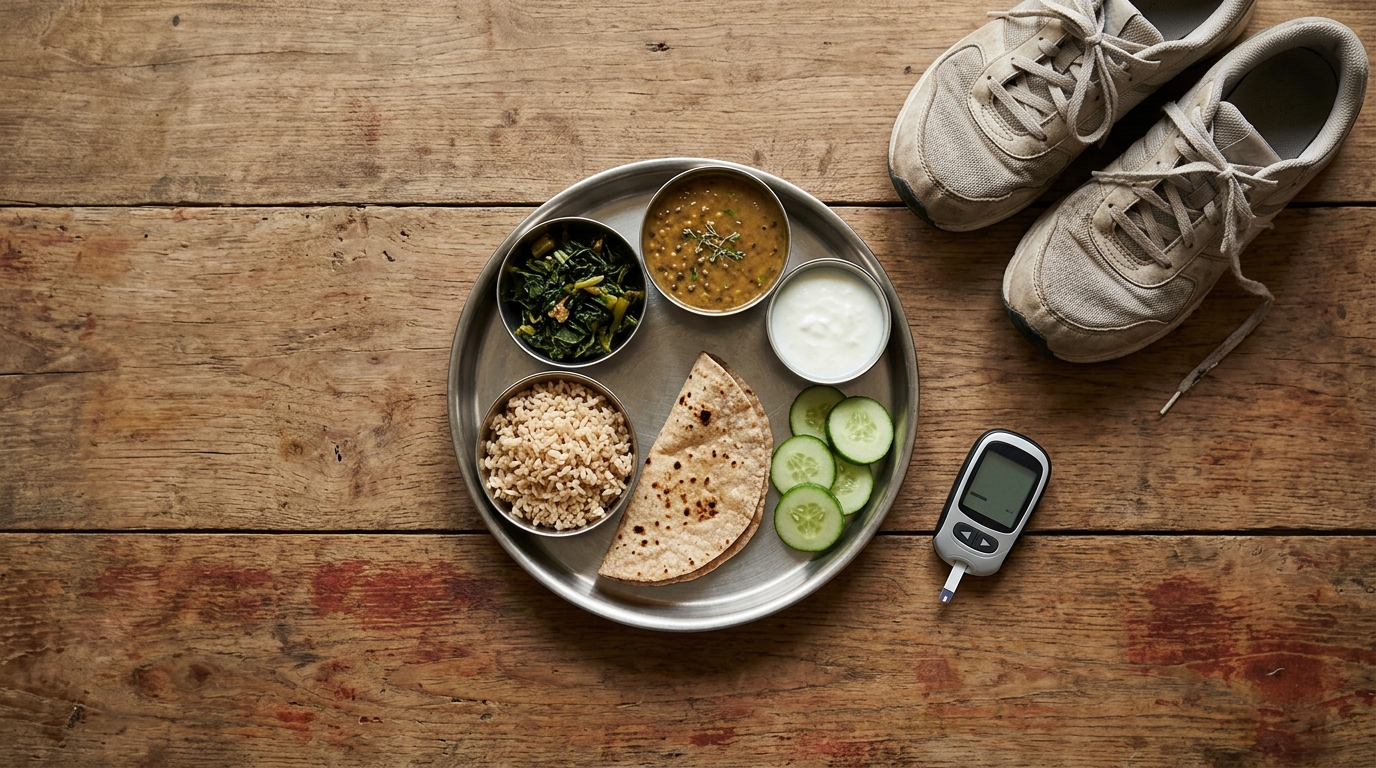
At a glance
- Single-arm study, two centres in Maharashtra: 87 adults with type 2 diabetes of up to 2 years, 6-month diet and exercise programme, medicines stopped at the start.
- Estimated remission was 60.9% under a missing-at-random assumption. Higher exercise adherence was independently associated with remission.
- With no comparison group, the authors call the findings hypothesis-generating. Controlled studies are needed.
Key result
An estimated 60.9% of adults with early type 2 diabetes reached remission after 6 months.
Diabetes remission (HbA1c <6.5% off medication), 6 months
60.9%
Estimated remission rate
The study
This was a prospective, single-arm interventional study from two centres in Maharashtra, India. It was published in Diabetes & Metabolic Syndrome and is registered with the Clinical Trial Registry of India. It enrolled 87 adults with type 2 diabetes (T2D) of up to 2 years' duration.
For 6 months, participants followed a culturally adapted local healthy moderate carbohydrate (LHMC) diet and daily structured exercise. The authors describe the diet as moderate in calories (around 1200 kcals) and the exercise as a simple, walking-based regimen. Glucose-lowering medicines were stopped when the intervention began.
The primary endpoint was diabetes remission. This was defined as HbA1c below 6.5%, measured at least 3 months after stopping glucose-lowering medicines. Secondary outcomes were body measurements, blood tests and continuous glucose monitoring (CGM) measures. Diet and exercise adherence were also monitored. There was no comparison group. The abstract does not report funding.
What they found
Seventy-five of the 87 participants completed the 6 months. The estimated remission rate was 60.9%. This estimate rests on a missing-at-random assumption.
Weight, waist circumference, HbA1c and lipid profile all improved. The authors call these improvements clinically meaningful. The abstract does not report the size of the changes.
Higher exercise adherence was independently associated with remission. This was in the context of a baseline reduction of approximately 500 kcal/day. CGM metrics were more favourable in the remission group. The authors note that exercise adherence and CGM measures were not prespecified as predictors.
How much weight to give it
The authors describe their findings as hypothesis-generating. They state that the absence of a comparator limits causal inference and that the findings warrant confirmation in controlled studies. With no comparison group, the study cannot show that the diet and exercise caused the remission.
Other limits:
- The 60.9% figure is an estimate that depends on an assumption about missing data.
- The study included 87 adults from two centres.
- Remission is defined by HbA1c, which is a surrogate outcome. The abstract reports no hard clinical outcomes.
- The abstract does not report baseline HbA1c, adverse events, hypoglycaemia, or how long remission lasted.
- The authors say this is the first study to show more than 60% remission with a moderate-calorie, moderate-carbohydrate Indian diet. This is their own claim.
- The link between exercise adherence and remission was not prespecified, so treat it with caution.
For your clinic
These results support further interest in culturally adapted diets and regular walking for people with recent-onset T2D. They also suggest that exercise adherence deserves attention alongside diet.
They do not give a basis for stopping glucose-lowering medicines in routine practice. Read the full paper first. Check who was eligible, how participants were monitored, and what safety data were collected. Controlled studies are needed before this approach is treated as a remission strategy.
Source
Evaluation of a local healthy moderate carbohydrate (LHMC) diet and structured exercise for diabetes remission in early type 2 diabetes mellitus: A nutrition intervention study from India.
Kale MC, Purandare VB, Tiwari S et al.. Diabetes & metabolic syndrome. 1 October 2026
For registered medical practitioners. This report summarises published research and is not advice for individual patients. Read the full paper and current guidelines before changing practice. Found an error? Write to editor@diabesityrounds.com; see our corrections and editorial policy.
More on type 2 diabetes
- Network meta-analysis: SGLT2 inhibitors versus finerenone in CKD with type 2 diabetesMeta-analysis · 14 October 2026
- Meta-analysis: SGLT2 inhibitors reduce heart failure or CV death in type 2 diabetesMeta-analysis · 14 October 2026
- Orforglipron with insulin glargine: larger HbA1c fall than placebo in phase 3Randomised trial · 11 October 2026
- twiist automated insulin delivery in type 2 diabetes: 13-week single-arm trialOther study · 10 October 2026
Go deeper
- CASPIAN Certificate in Obesity MedicineRegister interest for the next batch
- Beta Cell AcademyCME for doctors in Hyderabad
Today's Rounds, in your inbox at 8am
The day's reports each morning, and Weekend Rounds on Saturday. Free, no advertising.