The next wave of GLP-1 drugs: early promise, but cost and access still unclear
Four trials of oral, copy and triple-agonist incretin drugs show effects on HbA1c or weight, but the designs differ too much to rank the drugs or to change practice.
At a glance
- Oral safiglipron was non-inferior to dapagliflozin for HbA1c, with more gastrointestinal events. Oral orforglipron beat placebo on HbA1c in people on insulin glargine, but only a registry record is available.
- Synthesised semaglutide HD1916 met equivalence with Wegovy for weight loss in an open-label trial in Chinese adults. Triple agonist UBT251 lowered weight more than placebo in a 24-week phase 2 trial.
- The trials differ in population, comparator, endpoint timing and endpoint type, so they cannot be compared with each other. None reports hard outcomes.
This week's question
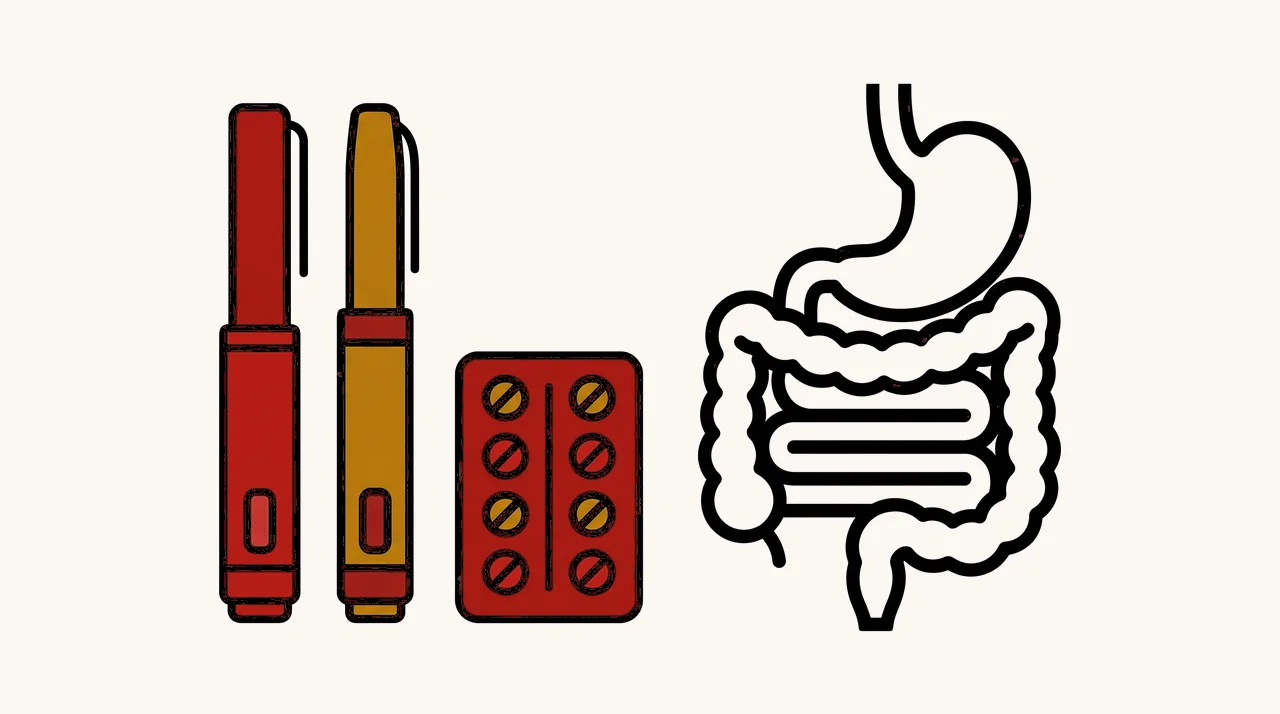
This week's reports cover four different kinds of GLP-1-based drug: two oral drugs (safiglipron, an oral small-molecule GLP-1 receptor agonist, and once-daily oral orforglipron), a chemically synthesised copy of semaglutide (HD1916), and a triple agonist (UBT251). For Indian patients, the practical questions are cost, access and choice. Do these trials show that the new options work, and how far can their results be trusted?
What the studies showed
Safiglipron. The safiglipron trial report describes OUTSTAND-2. This was a phase 3, randomised, double-blind, double-dummy trial at 98 sites in China. It enrolled 810 adults with type 2 diabetes (mean HbA1c 8.60%). Safiglipron 30 mg, 60 mg or 90 mg was compared with dapagliflozin 10 mg for 32 weeks. All three doses were non-inferior to dapagliflozin for HbA1c change (margin 0.4%). Only the 90 mg dose met the prespecified superiority criterion (difference -0.25%; 95% CI -0.45 to -0.05). The 60 mg dose did not (P = 0.0789), and fixed-sequence testing stopped. HbA1c below 7.0% was reached by 54.9-63.5% on safiglipron and 36.5% on dapagliflozin. Gastrointestinal adverse events were more frequent with safiglipron. Treatment was stopped because of adverse events in 3.9-4.0% on safiglipron and 1.5% on dapagliflozin.
Orforglipron. The orforglipron trial report is based on a ClinicalTrials.gov results record, not a journal paper. The phase 3, randomised, double-blind trial included 546 adults with type 2 diabetes on insulin glargine. At week 40, HbA1c fell by -0.77 with placebo and by -1.54, -2.05 and -1.90 with orforglipron 3 mg, 12 mg and 36 mg. The record lists three analyses against placebo, each with p <0.001. Their net differences are -0.77, -1.28 and -1.13, but the record does not say which dose each belongs to. It reports no confidence intervals, safety, weight or hypoglycaemia data.
HD1916. The HD1916 trial report covers a 44-week, open-label phase III equivalence trial. It enrolled 462 Chinese adults with obesity and without diabetes, randomised 1:1 to HD1916 or Wegovy. Mean body weight fell by 13.1% with HD1916 and 14.4% with semaglutide. The estimated difference was 1.35% (95% CI -0.02 to 2.72), inside the prespecified margin of ±4.16%, so equivalence was met. Any-grade adverse events occurred in 86.5% and 89.2%, mostly Grade 1-2.
UBT251. The UBT251 trial report describes a phase 2, randomised, double-blind, placebo-controlled trial of 205 adults with overweight or obesity and without type 2 diabetes. UBT251 acts on GLP-1, GIP and glucagon receptors. At week 24, weight change was -19.7% to -13.6% across UBT251 groups and -2.0% with placebo. Placebo-adjusted differences ranged from -17.7% (95% CI -20.8% to -14.6%) to -11.5% (95% CI -14.1% to -9.0%). The most frequent adverse events were mild-to-moderate gastrointestinal symptoms.
Where they agree and where they do not
All four trials are randomised, and each met its main endpoint. The oral drugs lowered HbA1c, the synthesised semaglutide matched its reference for weight, and the triple agonist lowered weight against placebo. Gastrointestinal symptoms were the most frequent adverse events with UBT251, and gastrointestinal adverse events were more frequent with safiglipron than with dapagliflozin. The HD1916 abstract gives only overall adverse event rates, and the orforglipron record gives no safety data.
Beyond that, the trials cannot be lined up against each other. The populations differ: type 2 diabetes in two trials, obesity without diabetes (HD1916) and overweight or obesity without type 2 diabetes (UBT251) in the other two. The comparators differ: dapagliflozin, placebo, Wegovy and placebo again. The primary endpoints were assessed at different times (weeks 24, 32, 40 and 44), and the endpoints differ (HbA1c in two trials, body weight in two). Two trials were run only in China. The orforglipron record does not describe where participants were enrolled.
The claims also use different words. Safiglipron was non-inferior to dapagliflozin, with the superiority criterion met only at 90 mg. HD1916 was equivalent to Wegovy. Orforglipron and UBT251 were better than placebo. Each word answers a different question. A drug that beats placebo has not been shown to beat any active drug. The weight figures should not be set side by side either. The -4.17% weight change with safiglipron 90 mg in people with diabetes and the -19.7% to -13.6% with UBT251 in people without type 2 diabetes come from different trials and cannot support any ranking.
What is still unknown
- Hard outcomes. None of the four reports gives data on cardiovascular events, kidney outcomes or other clinical events. HbA1c and body weight are surrogate outcomes.
- Safety detail. The orforglipron record gives no safety data. The safiglipron abstract gives no rates for specific gastrointestinal events. The HD1916 abstract gives no data on serious adverse events, discontinuation or immunogenicity. The UBT251 abstract gives no discontinuation data or per-event rates, and the safety of the glucagon-receptor component needs the full paper.
- Duration. The latest reported endpoint is week 44 (HD1916). The results of the safiglipron 20-week extension are not reported. The orforglipron study was planned for about 46 weeks, and the record does not describe what happened after week 40. How long effects last, and what happens after stopping, is not shown.
- Other populations. HD1916 and UBT251 enrolled people without diabetes (without type 2 diabetes for UBT251). Results for people with type 2 diabetes cannot be assumed.
- Orforglipron dose results. The record does not say which net difference belongs to which dose, and it does not compare doses with each other.
- Indian data. The reports do not mention Indian participants. Funding is not reported in the safiglipron, HD1916 or UBT251 abstracts. The orforglipron record names Eli Lilly and Company as sponsor.
For your clinic on Monday
These trials do not change prescribing today. They show where the field is heading, and they are not a basis for individual treatment decisions.
The Indian regulatory position differs by drug. An expert committee of India's national drug regulator has recommended import and marketing permission for orforglipron. As of September 2026 there is no final approval and no launch. The safiglipron abstract does not say whether the drug is approved anywhere. UBT251 is still in clinical testing.
For semaglutide, the Indian product patent expired on 20 March 2026 and a number of Indian manufacturers now make it. Indian-made semaglutide runs from roughly ₹1,300 to about ₹8,000 a month, depending on the manufacturer, presentation and dose. Most Indian semaglutide products are approved for type 2 diabetes rather than for weight, and only a few carry a weight indication. The HD1916 trial tested one product against Wegovy. Its results do not automatically apply to other manufacturers' products, and its availability in India is not known from these sources. If patients ask about cheaper semaglutide, check each product's approved indication and its own evidence.
When patients ask about these drugs, give the status drug by drug, as above: UBT251 is still in clinical testing, orforglipron has an Indian expert-committee recommendation but no final approval or launch as of September 2026, the approval status of safiglipron is not reported, and the availability of HD1916 in India is not known from these sources. Evidence on longer-term and hard outcomes is still needed, and one trial does not make a drug a treatment option.
Sources
A Phase 3, Randomized, Double-Blind Study to Investigate the Efficacy and Safety of Once Daily Oral Orforglipron Compared With Placebo in Adult Participants With Type 2 Diabetes and Inadequate Glycemic Control With Insulin Glargine, With or Without Metformin and/or SGLT-2 Inhibitor
Eli Lilly and Company. ClinicalTrials.gov results. 1 October 2026
Oral small-molecule GLP-1RA safiglipron versus dapagliflozin in type 2 diabetes: a randomized, double-blind, active-comparator-controlled phase 3 trial.
Guo L, Yu D, Xu Y et al.. Nature medicine. 5 October 2026
Efficacy and Safety of Chemically Synthesized Semaglutide Injection (HD1916) for the Treatment of Obesity: A Multicenter, Randomized, Phase III Trial.
Gao L, Ma Y, Zhang Q et al.. Diabetes, obesity & metabolism. 7 October 2026
UBT251, a novel triple GLP-1, GIP, and glucagon receptor agonist, in adults with overweight or obesity: A multicenter, randomized phase 2 trial.
Zhou Z, Cheng Z, Jin P et al.. Cell metabolism. 7 October 2026
For registered medical practitioners. This report summarises published research and is not advice for individual patients. Read the full paper and current guidelines before changing practice. Found an error? Write to editor@diabesityrounds.com; see our corrections and editorial policy.
More on glp-1 and incretin drugs
- Orforglipron with insulin glargine: larger HbA1c fall than placebo in phase 3Randomised trial · 11 October 2026
- Semaglutide in diabetic kidney disease: primary MRI outcomes not met in 52-week trialRandomised trial · 10 October 2026
- ADA and EASD 2026 consensus: earlier SGLT2 inhibitor and/or GLP-1-based therapy in type 2 diabetesGuideline · 10 October 2026
- Oral safiglipron versus dapagliflozin in type 2 diabetes: phase 3 trial in ChinaRandomised trial · 10 October 2026
Go deeper
- CASPIAN Certificate in Obesity MedicineRegister interest for the next batch
- Beta Cell AcademyCME for doctors in Hyderabad
Today's Rounds, in your inbox at 8am
The day's reports each morning, and Weekend Rounds on Saturday. Free, no advertising.