Smart insulin pens with bolus calculator lowered HbA1c more than tracking-only pens
In a 12-week randomised trial of 120 adults on multiple daily injections in South Korea, pens with a bolus calculator lowered HbA1c more than tracking-only pens.
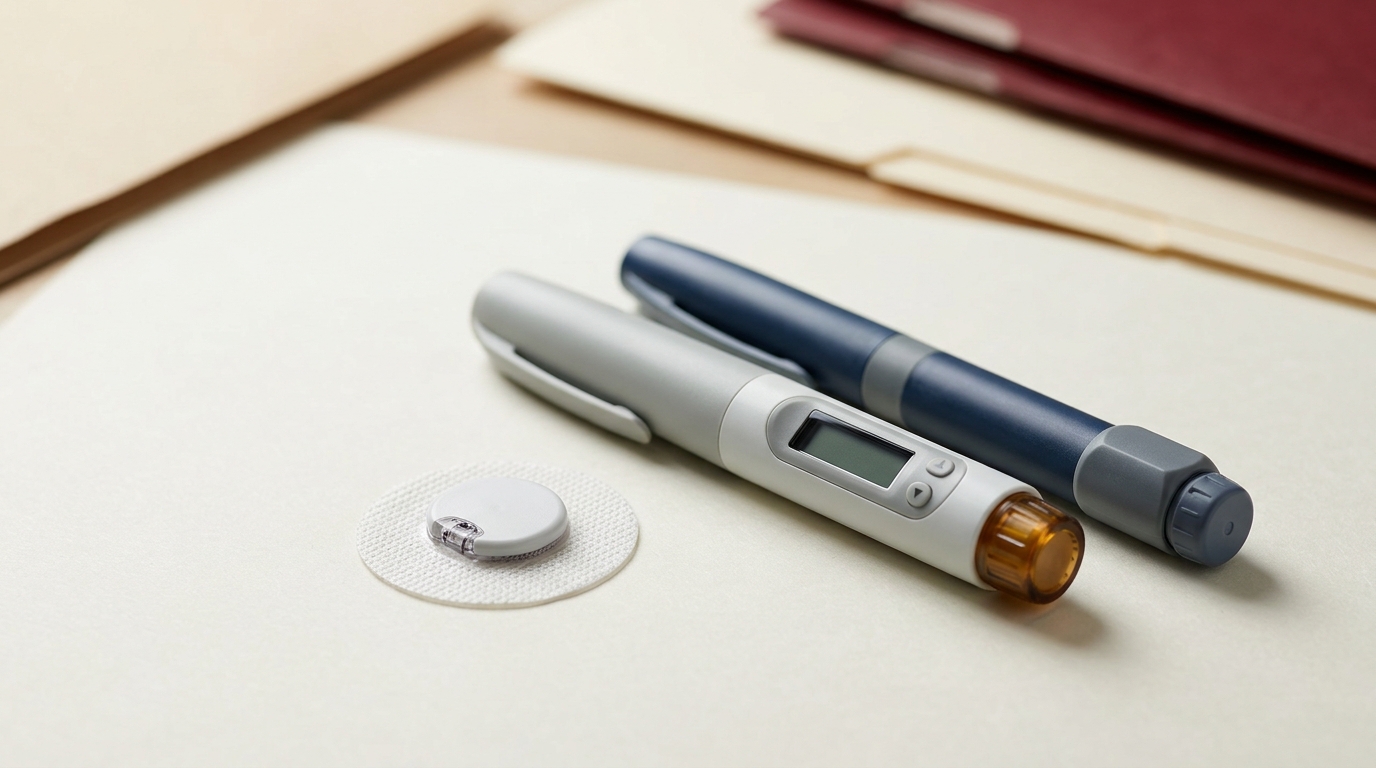
At a glance
- HbA1c fell more with smart insulin pens than with tracking-only connected pens (adjusted mean difference -3.39 mmol/mol [-0.31%]; 95% CI -6.45, -0.22 mmol/mol).
- Time in range was higher with smart pens (57.2% vs 50.8%), and users missed fewer bolus doses (3.4 vs 3.7 times/day).
- The trial was open-label, ran for 12 weeks, was supported by two companies, and all participants used CGM.
Key result
HbA1c fell more with smart insulin pens than tracking-only pens, by 3.39 mmol/mol.
Adjusted difference in HbA1c change, SIP vs CIP, Baseline to week 12
MD −3.39 (95% CI −6.45 to −0.22)
SIP vs tracking-only CIP
This report in under a minute
55 seconds. Free to use in your CME talks, with credit to Diabesity Rounds. Download the video · captions (SRT).
The study
This paper in Diabetologia reports a multicentre, open-label, randomised controlled trial at nine medical centres in South Korea. It tested whether a bolus calculator built into a connected insulin pen adds benefit over a connected pen that only tracks doses. The authors call the first type a smart insulin pen (SIP) and the second a tracking-only connected insulin pen (CIP).
The trial enrolled adults aged 19-74 years with type 1 or type 2 diabetes on multiple daily injections (MDI). Baseline HbA1c had to be 58-108 mmol/mol (7.5-12.0%). Participants were randomised 1:1, stratified by diabetes type, to SIP or tracking-only CIP for 12 weeks. All participants used continuous glucose monitoring (CGM). The primary outcome was the change in HbA1c from baseline to week 12. The trial is registered as ClinicalTrials.gov NCT06406439. It was supported by G2E Co., Ltd and Huons Co., Ltd, Korea.
What they found
A total of 120 people were randomised, 60 to each group. Mean (SD) age was 50.8 (14.8) years. Of these, 53 (44.2%) had type 1 diabetes. Mean (SD) HbA1c at baseline was 69 (12) mmol/mol (8.5% [1.1%]). The modified intention-to-treat analysis included 116 people.
HbA1c decreased more with SIP than with tracking-only CIP. The adjusted mean difference was -3.39 mmol/mol [-0.31%], with a 95% CI of -6.45 to -0.22 mmol/mol (p=0.036).
Time in range (3.9-10.0 mmol/l) was 57.2% with SIP and 50.8% with tracking-only CIP. The adjusted mean difference was 6.58% (95% CI 1.52% to 11.64%; p=0.012).
SIP users missed fewer bolus doses (3.4 vs 3.7 times/day; p=0.020). They also had a higher bolus frequency (3.2 vs 2.8 times/day; p=0.011). No severe hypoglycaemia or diabetic ketoacidosis occurred in either group.
How much weight to give it
The authors concluded that SIP with bolus calculator significantly improved glycaemic management and dosing behaviour. Randomisation is a strength, and the result for HbA1c was supported by the CGM time-in-range result.
Several limits apply. The trial was open-label, so participants and staff knew which pen was in use. The follow-up was 12 weeks, so the abstract tells us nothing about benefits over a longer time. The upper limit of the HbA1c 95% CI (-0.22 mmol/mol) is close to no difference, so the size of the true effect is uncertain. HbA1c and CGM metrics are surrogate outcomes. The abstract does not report rates of milder hypoglycaemia, results by diabetes type, or whether the groups were balanced on baseline measures other than those given.
All participants used CGM, so the findings may not apply to people who do not. The trial was done only in South Korea. The abstract names two companies as supporters of the study, but it does not describe their role in the trial.
For your clinic
This trial suggests that adding a bolus calculator to a connected pen may help some adults on MDI who are not at target. SIP users also had fewer missed bolus doses and a higher bolus frequency, but the abstract does not show whether these explain the HbA1c difference. The data do not show long-term benefit or benefit for people without CGM.
Before changing practice, read the full paper. Check how the bolus calculator was set up and supported, how the groups were balanced at baseline, and the full safety data. Decisions about devices for individual patients should follow local guidance and clinical judgement.
Source
Smart insulin pens with integrated bolus calculator vs tracking-only connected insulin pens in adults with diabetes on multiple daily injections: a multicentre randomised controlled trial.
Moon SJ, Kim JY, Cho JH et al.. Diabetologia. 14 November 2026
Teaching a session? Download this report as a slide (PNG, free to use with credit).
For registered medical practitioners. This report summarises published research and is not advice for individual patients. Read the full paper and current guidelines before changing practice. Found an error? Write to editor@diabesityrounds.com; see our corrections and editorial policy.
More on insulin, cgm and pumps
- StatStrip Gen 2.0 hospital glucose meter recall: results may go to wrong patientRegulatory · 31 October 2026
- CDSCO expert committee: Phase III trial of degludec/aspart mix recommendedRegulatory · 31 October 2026
- FDA flags most serious recall of Nova StatStrip Gen 2.0 hospital glucose metersRegulatory · 21 October 2026
- Smart MDI non-inferior to MDI plus CGM in type 1 diabetes with HbA1c of 8% or moreRandomised trial · 21 October 2026
Go deeper
- CASPIAN Certificate in Obesity MedicineRegister interest for the next batch
- Beta Cell AcademyCME for doctors in Hyderabad
Today's Rounds, in your inbox at 8am
The day's reports each morning, and Weekend Rounds on Saturday. Free, no advertising.
Or follow on WhatsApp or Telegram (every report, as it is published), watch on YouTube, listen on Spotify or Apple Podcasts, or follow on LinkedIn. Not sure? Pick one.